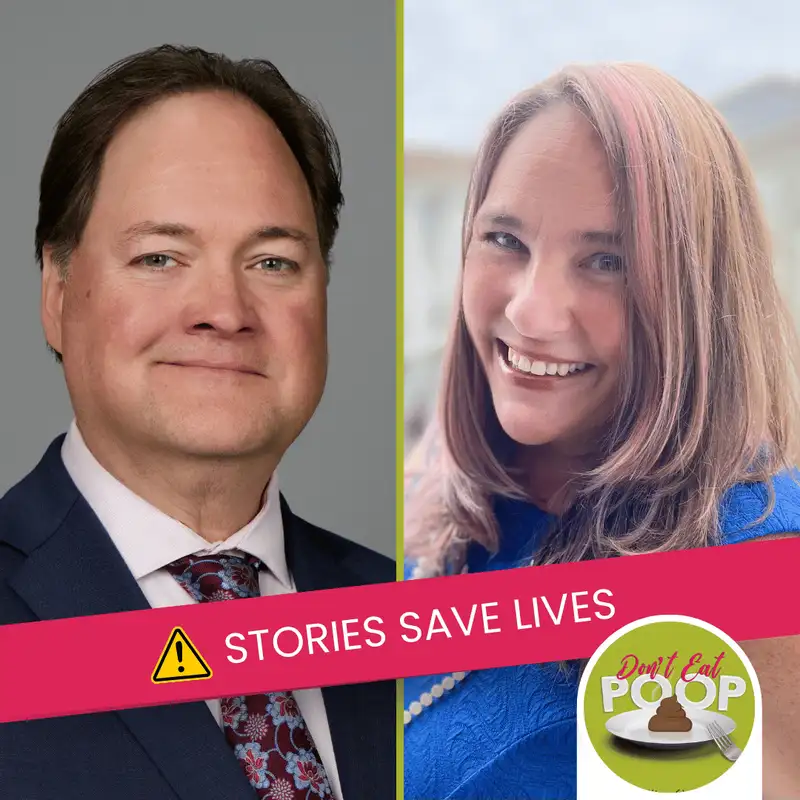
The Power of Storytelling in Food Safety with Dr. Darin Detwiler & Gennette Zimmer | Episode 175
DEP E175
===
[00:00:00] Darin: Here's what happens, and stop me if I'm wrong. And a top executive from a major company finally comes out and addresses the press or is on a stage about some failure, and they say the same things every single time. "We had an issue, and we want you to know how much we prioritize food safety. Food safety is our number one priority at fill-in-the-blank company.
And because it's such a priority, and we want you to know how much of a priority it is, we're going to make sure that we bring in some advisors, and we're going to invest in new technology, and we're going to invest in, in new protocols, and we're going to stop for a little bit, maybe a quarter of a day, and we're going to tell those people who are at the bottom of the totem pole they need to be retrained."
Every single time. That's like the common playbook for how a corporate responds to a catastrophic failure in food safety[00:01:00]
[00:01:01] Intro: Everybody's gotta eat, and nobody likes getting sick. That's why heroes toil in the shadows, keeping your food safe at all points, from the supply chain to the point of sale. Join industry veterans Francine L. Shaw and Matt Regusci for a deep dive into food safety. It all boils down to one golden rule: don't eat poop.
Don't eat poop
[00:01:26] Matt: Hello, hello, Francine.
[00:01:28] Francine: Hey, Matt.
[00:01:29] Matt: We have amazing guests today. Again, we have Jeanette Zimmer and Dr. Darin Detwiler. It's awesome that I get to say a name in front of Dr. Darin Detwiler, and it is both appropriate in every way possible. And we're gonna be talking about storytelling, food safety storytelling, and you guys are gonna be talking at Food Safety Consortium, and that is the...
Is that the [00:02:00] title of the talk at Food Safety Consortium?
[00:02:03] Darin: I think tentatively it's called The Storytellers, but it is about storytelling, and a very brief description of it is that there are plenty of examples of laws, regulations, food code elements, technology, data. All these things are out there, and there are so many great examples of people and companies who really do a great job when it comes to food safety.
But then there's those who don't. Either they delay or they do the opposite. We've seen plenty of examples of people who, you know, their names and stories are in the headlines for the wrong reasons. And so my thinking here is that there's gotta be something that's missing. There's gotta be something... A wall is not simply a collection of bricks.
You have to have that mortar that holds everything together. And storytelling, whether it is the why behind it or the [00:03:00] culture, why we have the culture, the history of this culture, the steps that got us to where we are, that does not find itself in laws and rules and technology. That finds itself within the stories that have to be told.
And we've been telling stories as humans since, well, since we were humans. The ways we've told stories have changed, whether they're in song or cave drawing, or Jeanette's favorite, interpretive dance, but I digress. Still, however the format may look or appear, it's a very important part of every culture, and I think it has to be an important part of food safety culture.
[00:03:38] Matt: Amen. You guys also have a podcast together called The Confessions of Food Safety A-Holes.
[00:03:45] Gennette: Oh, it's Confessions of a Food Safety A-Hole. I'm not a food safety a-hole. He's the food safety a-hole. I'm just egging him on. My whole job in the podcast is to egg the a-hole on.
[00:03:57] Darin: We're also
[00:03:58] Matt: gonna be discussing how [00:04:00] Dr.
Darin Detwiler is ending an era of teaching for how many years now? 30 years?
[00:04:08] Darin: And that's not even including when I was an instructor in the Navy. But I started a long time ago teaching, and I have been teaching pretty much ever since. And there was even overlap. I was teaching public school the same time I was teaching at a local community college.
And yeah, it's 30 years of teaching, which is another form of storytelling, 'cause I've many stories in teaching.
[00:04:33] Matt: Good teachers tell stories. We've all had teachers that just go through the book and you're like, "Lordy, is there anything more to offer than the book? Can I just read the book and take the test?
Like, why do I have to go to class?" But you would not be that type of teacher. No. I'm sad I wasn't able to be in one of your classes actually, 'cause that would've been-
[00:04:53] Darin: Actually, you know what's kind of funny is, I'll, I'll grab this here 'cause I have it. When I was, for four years I was a middle school [00:05:00] teacher.
I taught US history. I was the admiral of smartology.
[00:05:05] Matt: For those of you who don't see, he just put a hat on that said smartology on it. It's a black and white hat
[00:05:12] Darin: Kind of explains itself, but I wasn't just Mr. D, I was the Admiral of Smartology, and students from far and wide came to hear my stories.
[00:05:24] Matt: Mr. D, the Admiral of Smartology.
It has a ring to it. It does. Okay, so where do we want to start? Do we want to start with storytelling? Do we want to start with your teaching career? It's interesting because I don't want to say it came to an end. Just teaching within an institution, having a, like a full-time job teaching may come to an end, but this is an evolution of where you're going in your career.
And then also, Jeanette, how does this work with your marriage? Because you are an extreme introvert, and he is not. This took up a lot of his time. What is he gonna do with that time other [00:06:00] than drive you freaking crazy?
[00:06:02] Gennette: Well, so yes, part of it is that I have always encouraged him, outside of the university stuff, to...
'Cause he's a joiner. He likes to join the clubs and stuff, so he's a part of the Lions Club, he's part of the Seal Beach Chamber of Commerce. He's part of the USS VI. So he gets out quite frequently, and he's also an idea generator. So he'll literally get up, we'll be in bed ready to go to sleep, and then he'll be like, "Oh, wait, I'll be right back."
And then he'll disappear for, like, an hour, and he had come up with an idea for an article, and so he'll just go hop on his computer and type it up and send it off to one of the magazines. So even though he's been doing the university, after he left the assistant dean position, the amount of time that he focused on class and university stuff was already [00:07:00] reduced.
So for me, it's not gonna be a humongous change. It's just he would do classes one night a week, where I would just pick the television show that I would watch that he never watched, that now we're gonna have to negotiate for that because when he's up there Wednesday nights for open office hours for his classes, I was enjoying whatever TV show he was not interested in watching.
So that one will take a little bit more negotiation.
[00:07:29] Darin: Yeah. There was a while back when, right after we moved during the pandemic from the Boston area to the Southern California area, I joined the Lions Club For whatever reason, this little town we live in has a huge Lions Club. Literally, it is registered as the largest Lions Club in the Western Hemisphere of the world.
And they do a ton of projects. And so I join them, and you have to go in front and say, [00:08:00] "Hi, my name is Darin. I'm joining the Lions Club. This is what I do." And then they ask you, "So why did you join the Lions Club?" And my answer was, "Because my wife said I need to get out of the house and make some friends."
[00:08:12] Matt: 'Cause if you need to go out and make some friends
[00:08:15] Darin: What's sad but also telling is that everyone in there knew exactly what I was talking about, and it resonated with that reason. But it's crazy though that I find ways of overlapping a lot of the things that I... I used to focus on the submarine veteran, the USSVI, the United States Submarine Veterans Inc.,
as my departure from always focusing on food, and yet there's so many ways in which they overlap from time to time. And I'm on the Olympics Committee, 'cause the LA Olympic Games in 2028. I'm on the local Olympics committee, and a lot of the times I'm focusing on, okay, how are we gonna deal with food distribution and food safety and cold storage with the transportation disruption and the isolation of the areas, and talking with other resources.
So it's [00:09:00] kind of one of those things. If you let it, everything will overlap and start to tell a story because you've now tapped into all these different cultures or areas of concern.
[00:09:11] Matt: Mm-hmm.
[00:09:11] Darin: And that's one of the reasons why I'm always coming up with different story ideas or different concepts of different things, is because of being in these different cultures and seeing where there's overlap.
[00:09:22] Matt: So you've been teaching at Northeastern for how long?
[00:09:25] Darin: I've been teaching at Northeastern for 14 years. I taught at Bellevue College for five years, and I taught in public schools for 16 years. And when you do the math, you realize, oh yeah, I started 30 years ago. And then you realize, my God, even my students are old.
That makes me really old. You know, my youngest just turned 30 yesterday, and he's a teacher and a musician. And what I find funny is, was a couple of years ago, Jeanette, when he was probably 25 and he started teaching, and he's like, [00:10:00] "Dad, my students, they think I'm old." I'm like
[00:10:07] Francine: There was a time when I started in food, I was the youngest.
I was very young. And then we were all the same age. And then I got a little bit older. And then I had kids, and then my kids were the same age as some of those kids. And then suddenly I was like, "Oh my God, now I have grandkids that are like..." And then these, the kids that work for me had kids, and it's like, "Oh my God, now I'm old."
[00:10:28] Darin: Last month, Jeanette and I were in Chicago, and I was interviewing an executive for a food company, and we found out we both have the same birthday, which was like two days after the interview For yet another podcast. And she goes, "Yeah, it's crazy. We have the same birthday." I'm like, "Yeah." And she goes, "This one's gonna be a milestone."
I go, "Oh?" She goes, "It'll be my last birthday where I'm still in my 20s." I'm like, "Oh my
[00:10:58] Matt: God." So at North- [00:11:00] Northeastern, you were a dean for a while.
[00:11:02] Darin: I went from adjunct to lead faculty, and assistant teaching professor, and associate teaching professor, and then in there I was an assistant dean for four years.
And I tell you, my recollection of being an assistant dean was, and, and Jeanette, correct me if I'm wrong, on average 12 hours a day. This is during the pandemic when we're working remote 12 hours a day being on Zoom calls and fixing everyone else's problems, and then my blood pressure went through the roof
[00:11:35] Gennette: When he decided to leave the assistant dean position and just go back to teaching full-time was absolutely the best decision because he was actually around more.
Yes, you joke that I am an extreme introvert. I'm an extreme introvert with other people, but I like having him around. So when he was literally just in his office all day long, and I had a full-time job at that time as [00:12:00] well, so the 9:00 to 5:00 period of time, it made sense, but then he'd still, 5:00 o'clock would come and go, and he'd still have to be doing stuff, and I'm like, "All right, I guess I'm, I'm entertaining myself."
So when he left the assistant dean position, it was a lot of work for very little gratification, feeling like he accomplished anything, and we hardly got to spend time together. So it was the best thing for us when he went back to full-time teaching, plus he likes teaching. He likes being a teacher. I'm sure he'll find ways, even if he's not full-time at a university, he'll find ways to still be a teacher.
[00:12:39] Darin: Right. Yeah, and I think part of it is, is that you have this opportunity to be even online teaching, which is what I've done for the last six years purely. I have my usual Wednesday or Thursday nights where every single week it's just like this, but with my students in a Zoom call kind of a thing, and what's crazy [00:13:00] is how many of the students will say, "Wow, my other professors don't do this, and it's really cool that we get to hang out for an hour and talk about this, and what was going on in the discussion boards, and how are we gonna prepare for this assignment?"
But in addition to having those meetings, you've seen some of these videos. I interview so many people at conferences or I go to their work or Zoom calls. There's a class I was teaching on recalls where I created 39 videos looking at foundations and then before, during, and after recall. I created a series of 39 interview videos.
Now mind you, a lot of these videos are only like 10, 15 minutes long, but my students would watch me on demand Asynchronously, they would watch me interviewing various people, different health department or this company or this level of government or some big names kind of stuff. And that was just part of what I would do in terms of preparing to teach even.
So it wasn't just the storytelling [00:14:00] live, it was also the storytelling on demand and with different people, and the, the conversations I would have with people. And the feedback I got and the student evals always reflected that the storytelling, whether it's me telling or me interviewing someone, was the highlight of the course because it made it real.
It, it... I mean, there were students-- I remember this, Jeanette, I don't re- remember if you recall when I interviewed the director of sustainability for the city of Long Beach, California.
[00:14:28] Gennette: Oh, yeah, I remember that video.
[00:14:30] Darin: And she went on to become the director of sustainability for the state of California. But my students' first comment was, "Wow, this was a really good interview."
Their second comment was, "I didn't even realize this was a job. How cool is this? Sustainability director for a city and, and state kind of stuff." And so one of the things I started doing was not just tell me the answer to this problem and tell me about this policy. I would start asking my [00:15:00] guests, "So what is your job?
How did you get to this job? What was your trajectory? What was your career path? How did you get to this?" Because so many times the students were finding out that, oh, they're here, they're trying to, in some cases, figure out their career. To hear about other people's career was great. And then I would get the feedback, "Professor Detwiler, why don't you tell us about your career path?
How did you get here?" Because we always have professors, and professors never usually tell us how they got to this point kind of a thing. And so I found it, yeah, I have to remember that sometimes telling my own story is also important to my students.
[00:15:34] Francine: Right. And many of us didn't end up where we are intentionally.
It's not where we planned to be.
[00:15:41] Matt: Yes, and a lot of times, too, in my career, I was like, "Wait, there's no position for this? Well, then I'll create it, and I'll take it."
[00:15:48] Darin: That's funny 'cause Jeanette and I, we had that conversation, oh my God, like 10, 11, 12 years ago. I was trying to find the perfect job, [00:16:00] and she's like, "Well, maybe there isn't a perfect job.
Maybe you have to make your own, make your own path kind of a thing." And it's also funny, too, that when we first started dating, I was a public school teacher, and when we moved in together, when we relocated to the Boston area Jeanette, what was the whole conflict between me and the universe in terms of t- me telling them what I wanted to do?
[00:16:29] Gennette: Yeah, so I'm a pretty California woo-woo kind of girl. I totally believe in the California manifesting universe and all of that stuff. So Darin and I are living together. He's been applying, and he's trying to get the state of Massachusetts to look at his documentation so that he can get at least a temporary license to become a public s- educator in Massachusetts and all of that stuff.
At the same time, I noticed he started contacting some food safety professionals, people [00:17:00] in the area, and he's trying to build something from this passion that he's had, but has never taken seriously as, like, a career or anything. And I basically said to him, "The universe is confused. It doesn't know what you want.
You're applying for school educator jobs, but you wanna work in the world of food safety." I said, "You need to just pick one and go for that, and once you do that, then things will start to fall into place." And I was 100% right, 'cause once he stopped applying with the state of Massachusetts, stopped trying to get that position, and just focused full force on that, he ended up getting the job at Northeastern.
He did a short stint with Stop Foodborne Illness, and then he's speaking on stages regularly. But he needed to basically put it out there, "I want... This is where my passion lay. I wanna do this." And so [00:18:00] that's what ended up happening for us, was he ended up building that career off of being very clear about what it was that he wanted.
[00:18:07] Matt: That's awesome. I remember, like, six years ago, six, seven years ago, you called me up. I mean, when you were dean, and you were like, "Hey, we could use a teacher like you. Do you wanna teach?" And I was like, "Yeah, that'd be fun. What does it take?" And you're like, "Maybe you could teach about supply chain or something like that.
I don't know. We'll figure it out." And then we were having a conversation about it, and then you're like, "So what do you have your master's in?" And I was like, "Oh, you need a master's for this? I have a bachelor's degree." And you're like, "Ah, yeah, no, not in university. You need a master's degree, bro." I was like, "All right."
You could create your jobs. If you can't teach at a university without the right degree, you could still be a teacher. It's just different.
[00:18:50] Francine: Right, yeah.
[00:18:52] Darin: It is strange when you look at the kind of hold-ups. I do find it strange, too, because even in the world of food leadership, [00:19:00] you'll see someone on stage, and you're like, "Oh, that's the biggest name from that company.
That's the biggest name from that company. That's the biggest name from the government." Blah, blah, blah, blah, blah, blah, blah. And then you go looking at their LinkedIn profiles, and it's like- "Wow, she only has a bachelor's degree," or there's no rhyme nor reason. There's no consistency in certain elements in terms of your level of education or experience.
But at the university level, as a minimum threshold, you have to have this kind of a thing. It's like, ah, well, that's something we can't do. We can't adjust that. But again, I think that sometimes you have the people who have... They meet the re- requirements, but they're not necessarily the people that are truly qualified to tell the story.
And I wanna piggyback too on something that Jeanette said. That kind of saying one thing and another thing, and they're conflicting, so you're confusing the universe. What is the universe supposed to interpret from what you're saying kind of a deal. I think that really actually applies to what [00:20:00] we see in food safety as well, in terms of you got someone with a job title that says food safety or FSQA or director of whatever it is.
They all have so many people that do the same job, they all have different titles, right? You have a food safety department, but then we see a, a company that is doing things that don't make sense. They're not prioritizing this. They're not investing in this. They're not testing these things. They're not doing these certain things.
It's like even that becomes confusing because they're saying these things. They're talking the talk, if you will, but they're not truly doing what we would assume would be done It's easy to pick on Peanut Corporation of America. You have someone who's literally, you know, in charge of food safety and quality assurance, a quality, a QA supervisor for a company, and yet they're doing things that are clearly not safe practices.
Even looking at the concern over the very recent concern over the baby formula right now, you start looking at [00:21:00] the bigger story that's being told in terms of, "Oh, it's a brand-new story." No, it's not. You were told this years ago. You just decided not to act on it. So that clarity in the story I think is important, but also when we look at the bigger picture, right?
You can go back and look at, oh, the central distribution center in Arkansas for the Family Dollar stores had an issue, and they paid a huge fine kind of thing. Okay, yeah, but they also ignored multiple state-level inspections on this, and it wasn't until the FDA came in that they finally took action. Well, there was that brief problem they had at Boar's Head.
Okay, but Boar's Head had over 65 USDA reports pointing out their sanitation failures. Oh, this company had this. Okay, this h- this company had a long history of the same exact problem. This same ingredient was taken off and put on the menu, or this same problem was existing at that same location for a very long time, and they just [00:22:00] continued as business was normal.
So part of the problem that happens with the food safety story is it's minimized to being like the facts, and when we don't understand the history behind it, we don't understand how that became the big focus of the story or how come that was something that changed the entire industry. And it's very easy whether you're forgetting the facts between 1993 with Jack in the Box, or you're forgetting all the facts with Chipotle, or you're forgetting all the facts with...
I could keep going on and on and on. How come FSMA came along? Because of the various problems we were having with different produce, and the problem with testing and treatment of water for irrigation issues. And there's just that tendency for the specific kind of nuances of the story to get lost, and then you gotta wonder, "Well, how come this executive did or did not make this decision that was needed in this case?"
Maybe they didn't know the full story.
[00:22:58] Francine: And it's very [00:23:00] easy as these stories continue to be told for a lot of those facts just to be left out
[00:23:09] Matt: Oh
[00:23:09] Francine: yeah.
[00:23:10] Matt: For instance, I don't know if you purposefully understated every single one of the stories, but you're like, "The distribution in Arkansas." You mean the one that you couldn't walk without stepping on rats?
That one? Or the small little problem with Boar's Head, the one that killed people and got people sick with listeria? If you were purposefully understating that to make a point, then bravo, Darin. Do
[00:23:34] Darin: you have any idea how hard it was to control myself to, to limit what I was saying?
[00:23:39] Francine: When you did that, and, and I, I understand as you were going through those, you're just briefly talking about these stories.
But so many people that do what we do will just be like, "Well, this was the story and these situation." And they just ice over the details. And it's like, no, that's not what [00:24:00] happened.
[00:24:00] Darin: Here's what happens, and stop me if I'm wrong. And a top executive from a major company finally comes out and addresses the press or is on a stage about some failure And they say the same things every single time.
"We had an issue, and we want you to know how much we prioritize food safety. Food safety is our number one priority at fill-in-the-blank company. And because it's such a priority, and we want you to know how much of a priority it is, we're going to make sure that we bring in some advisors, and we're gonna invest in new technology, and we're gonna invest in, in new protocols, and we're gonna stop for a little bit, maybe a quarter of a day.
And we're gonna tell those people who are at the bottom of the totem pole they need to be retrained." Every single time. That's, like, the common playbook for how a corporate responds to a catastrophic failure in food safety. And yet, okay, what are they not saying? Well, what about the retraining of the top [00:25:00] executives?
Or what about the fact that they could have been investing those things all along, but they didn't until they had to? Or what about the fact that if your priority, if your number one responsibility and priority truly is food safety, then why did you allow this to go on for eight years? They don't address those things.
They sugarcoat it. And again, they read the playbook, if you will.
[00:25:21] Francine: Well, right. And then suddenly these professionals that they brought in to help them forget that there was a real story as well- Yeah ... sometimes. I don't know. Yeah. I just- Or
[00:25:31] Darin: they change the story. "This company has exhibited the greatest leadership and response, and they're gonna set new standards for the industry.
Because, you know, we had a little problem that killed 10 people, but we had a little problem,
[00:25:44] Matt: you
[00:25:45] Gennette: know?"
[00:25:45] Francine: Like, did you not see the same thing we saw? I'm sorry, we got a little off track with our story there.
[00:25:51] Matt: There is power in whoops. There... Like what you said, there could've been that there was... And, and it could've been structurally designed to be this way as [00:26:00] well, where some of the stuff just wasn't getting up to the top where decisions were made.
And even if they were noise, and they didn't realize how important this really was until all of a sudden something catastrophic happened, and then they're like, "Oh, shoot."
[00:26:16] Francine: Well, then that's a problem. Right.
[00:26:17] Matt: Whoops.
[00:26:18] Darin: Right.
[00:26:18] Matt: No, totally. And so I do want to say that there is... Should've they have had those in place beforehand?
Yes. And that's part of what the podcast is about, both of ours, right? Is to get those stories in front of people so that they can make those structural changes now instead of a whoops.
[00:26:35] Francine: I want our editors to capture Darin's face right now.
[00:26:38] Matt: I know. I know. It's, it's the same face as Jeanette, which, when Dr.
Darin was talking about being a dean. It was distressed face.
[00:26:48] Darin: I guess what's going on in, in my head though, coming out, that you can read it on my face, is that there are two other kinds of participants in this story, if you [00:27:00] will, that I've encountered. One is the food safety professional Who just feels like they're drowning.
That this seemingly endless cycle of failure and reform, this incredible struggle to say, "Hey, we need to be proactive," or, "We need to preventatively invest in this because the best crisis is the one we prevented, and the best investment is a proactive investment because a company can't justify spending $5 million to prevent something.
But after the headlines hit the fan, now we can invest $100 million in it."
[00:27:34] Francine: Right. Right.
[00:27:35] Darin: But the other person is the, the parents who... And I'm not even just talking about the advocacy kind of parents, but the, the parents who've gone through the loss of a child or the sickness and hospitalization of a child, and they usually follow the same pattern.
They never thought about food safety until their own family was in the crosshairs. And whether or not [00:28:00] they were able to bring a child home, and whether or not that child had long-term medical complications, this was something that impacted their family. And at one point, they may have even made the headlines of their local newspaper or even been talked about at a conference.
And then literally two, three months goes by, and they feel as if they were just a statistic. And for those families that are living with the lifelong medical complications or with that chair forever empty at their family home Those are the families that kind of reach out to us, especially after the Netflix documentary, and will say, "Thank you for sharing this story, because I feel as if my family's story is just completely ignored and just became a statistic.
And yet to see you telling the story, it was so validating in that there are other people out there that share this experience. I'm able to share this experience with my friends and family because they don't really, truly understand what my kid went through." [00:29:00] And again, when you don't see the story about food safety, the reality of food safety and its impact...
I mean, oh, look at, w- yeah, ER, and Chicago Hope, and Grey's Anatomy, and how many times did someone have a subdural hematoma or all these different fantastical things? Jeanette collected data on all this kind of stuff with medical shows.
[00:29:21] Matt: Is that one of the shows that she wants to watch, but you're gonna be sitting on the couch and you don't want to, or is that-
[00:29:26] Darin: Oh, 100%.
She watches Grey's Anatomy, and every time... And she's gone back and watched Grey's Anatomy over and over again. And when I pop it in my head, it's always, is this before or after George was killed? It's like, there's only two timeline elements of that show that are, are in my, my, my awareness. It's before or after George, basically.
But I mention the medical shows because it's amazing how many times you would think there would've been an opportunity to have a storyline like what happened in 1993, like what happened with Chipotle, what happened with [00:30:00] all these different food safety failures in a hospital setting. But times have changed And one of the things I've talked about is that back in 1993, 1994, they were gonna do a TV movie about what happened to my family in Seattle with Jack in the Box.
And at some point down in the process, they pulled me in and said, "Hey, we're gonna cancel this project because there's not enough sex and violence in it to sell it to the mainstream audience." And that was a crazy story to give me as to why the story wasn't good enough for television. And so it's crazy when, "Oh, no one will buy this book.
No one will see this on TV." 30 years later, well guess how many books and conferences and websites and podcasts and webinars, and even an Emmy Award-winning documentary there is telling these stories about the reality of food safety from the consumer and even from the food safety leadership or expert [00:31:00] kind of perspective.
So the storytelling has changed over the last three decades.
[00:31:06] Francine: Yeah. Well, I think people too have learned that storytelling is the way to go, that that's what people wanna hear. They wanna hear stories, and people relate. Look how many documentaries there are these days. It is crazy how many documentaries there are on TV, and how many people are drawn to documentaries, and that didn't used to be the case.
People like stories, and they like real stories. They like the human element.
[00:31:34] Matt: Yes. So at the Food Safety Consortium, is the talk that you guys are doing, is it gonna be a panel?
[00:31:39] Darin: So we have a few things going on. I'm involved in a few things going on with the, the Food Safety Consortium, which is this, uh, later in October.
One is this panel on storytelling, and Francine, you're on that panel, as is Kristen King Talking about her adventures with food [00:32:00] safety, but through the eyes of not food safety per se, but more cybersecurity. And we have some other panelists, and Jeanette's gonna be moderating it. She's not only the co-host of this podcast, Confessions of a Food Safety A-Hole, but she also hosted another podcast before this podcast.
And we thought to have me as a storyteller as the moderator is odd, and I think it was a really good idea that she pitched in terms of her being the moderator of that panel. In fact, Jeanette, why did you think, "Hey, it'd be a good idea to be a moderator of that panel"?
[00:32:37] Gennette: Why did I think it was a good idea?
Not
[00:32:39] Darin: why as in justify a good point you were making in terms of-
[00:32:42] Gennette: Why did you
[00:32:43] Darin: think
[00:32:43] Gennette: you were
[00:32:43] Francine: the
[00:32:43] Gennette: right person,
[00:32:44] Darin: Jeanette? Yeah. Why? Tell us now.
[00:32:46] Gennette: Part of the reason I thought that I was the right person is because I've heard the stories, I know the stories, I've spoken to a lot of the people, especially the people on the panel.
But I'm also kind of on the [00:33:00] sidelines of all of this. I am not a main advocate for all of this. Or let me rephrase. I'm not a main activist speaking actively about food safety. I'm more of an advocate where I'm supporting all of you in all of the endeavors that you have. And so it seems really appropriate that I be the one who is drawing the questions out for you to talk about storytelling to the audience.
And I do a bit of the storytelling myself through Confessions, but for the most part, I think that it's also where I am at this point in this world seems appropriate for me to be the moderator of the storytellers. And you do a fabulous job, by the way.
[00:33:51] Matt: Yes.
[00:33:52] Gennette: Thank you.
[00:33:53] Darin: Well, I think, too, it's like Matt, your wife has to live with [00:34:00] what you bring back into the household from your daily activities.
And Francine, you can't necessarily close the file as soon as you're off the clock, if you will. I think all of us are guilty of all the people around us in our personal lives, we radiate our frustrations, our ahas, our take on certain things, and our friends and family sometimes become those kind of captive audiences.
And over years... Actually, I think what's kind of funny is when I was doing my doctorate Jeanette, I think it was the week before I was defending my doctoral thesis, you said something to the effect of, "You know, if you get sick or lost your voice, I've heard it so many times I could probably defend your thesis for you."
[00:34:46] Francine: I can defend your thesis on your behalf. So I was gonna tell you guys something before we started. I can become so focused and so engrossed in what I'm doing that I just literally don't hear what's happening around [00:35:00] me. Last night I was working on something. We were waiting for one of our grandchildren's ballgames to start, and we were sitting in the truck, and I w- I was working on it on my phone, and I'm so engrossed in what I'm doing.
My husband's sitting on the other side of the truck talking to me. I literally did not hear him. He sent me a text. I love that. And I just looked at him and I said, "What?" He said, "I'm trying to talk to you." And it's like, I said, "You were talking?" And he said, "Yes, I've been trying to tell you something Honest to God, I did not hear a word.
He said, "Yes, I know." Oh my God. And I feel so bad that I truly... Now granted, I'm deaf and do- did wear two hearing aids, but that wasn't the case. I literally can just block everything out, stay focused on what I'm doing, and hear nothing. Yeah. Darin, I was probably reading something of yours.
[00:35:57] Darin: Jeanette, what is that unwritten agreement we [00:36:00] have of what happens when your phone is in front of your face?
[00:36:03] Gennette: Francine, I think there is actually something physiological that happens when you are focused in your phone that turns off your ears. Because he's done the same thing where I'm on my phone doing something and he's trying to talk to me, and I've told him that if he wants my attention, he has to tell me to put down my phone so that I can focus on him.
It's not in a weird assertive way, it's just a, "I know you won't hear me if this phone is anywhere near your face." 'Cause literally I hear... My ears literally turn off and I'm just focused in on what is going on, whatever I'm
[00:36:44] Francine: doing. Reading a book in my phone or if I'm working, 'cause I will- Yep ... do work in my phone, like- Yeah
write something or what. Nothing. I heard nothing.
[00:36:54] Gennette: Yeah. Now Darin, that's not really a big problem for him, but that could just be that I have a loud, shrill [00:37:00] voice. I don't know. But-
[00:37:01] Francine: As do I ...
[00:37:02] Gennette: I can always get his attention.
[00:37:05] Francine: I will make sure you
[00:37:05] Gennette: hear me.
[00:37:07] Darin: I have learned, though, that I need to stop and make sure she's aware that I'm telling her a story before I've told two-thirds of the story, because then she does this thing like, "Oh, were you talking to me?"
She looks up from her
[00:37:20] Gennette: phone. It's embarrassing, but it happens. He's never had to text me. He's never texted me, though. So I think you've now given him an idea, Francine, of something- Well, what if it's just Francine?
[00:37:31] Francine: What?
[00:37:31] Matt: This is probably why my wife has convinced me to have babies for so long. We did the number.
We've had 21 children in our house, different children in our house. Because when I wanna tell her something and she's holding the baby, I will grab the baby- No ... and then tell her things, and then she's focused on two things. One is my story, but also making sure that I'm doing the right thing with the baby, so it's doubly focused.
Then yeah, it works really well. So I guess that's the other part of the storytelling too that maybe you guys thought [00:38:00] about, maybe not thought about, but storytelling is one thing, but having the focus of the person who's listening is really im-
[00:38:07] Gennette: Also true. So I think that has a lot to do with how you're getting your story across.
Yes. Where... What are people... Like, where is their focus? When you're in a room standing in front of an audience, they're mostly a captive, you know. I mean, there are always... You look around, you notice there are a few people that are on their phones, but most people actually paid to be there and want to hear what you say when you're actually on stage.
But finding other ways to get those stories across is, like doing these podcasts, is a huge way to get people to engage and listen to what you have to say.
[00:38:49] Francine: So during COVID, that's the one thing that I hated. I was so used to speaking in front of people, that suddenly we couldn't see the audience, and you didn't know...
When you're [00:39:00] speaking live, you can change what you're saying if you're losing or if the audience are- Mm-hmm ... see that they're not interested or paying attention. You can change the tone or just what you're doing and modify things a little bit. When you can't see who you're speaking to, it's an entirely different game.
And I- Yeah ... hated that. I hated that. Yeah, but it,
[00:39:23] Darin: it is crazy, though. I'm fortunate to have been teaching at a time where students didn't have cell phones, and then by the end of when I was doing public school teaching, you know, oh, s- students can't have cell phones in the classroom and that kind of stuff.
And at the university level, I still had times where I'm like with an in-person class in the classroom telling people to put away their computer, their laptop, because there's no need for them to have it ar- right now, and you find out that they're like watching a TV show or playing a video game on their computer.
[00:39:54] Matt: Probably Grey's Anatomy.
[00:39:55] Darin: Yeah, Grey's Anatomy.
[00:39:57] Matt: Getting
[00:39:57] Darin: caught up. Grey's. Then I [00:40:00] have to ask, is this before or after George? But it's crazy too when you go to a conference sometimes, and I hear it more and more. Let's everyone silence your phone, put away your phone. This is not a place for emailing or for whatever.
You know, we want your attention up here kind of a thing. And it's like you can see this creeping into, it's not just kids or teens, it's even adults who may or may not be executives for companies and still in their 20s, that you have to remind them, "Okay, put away your devices." But look at, we, we do this with driving, distracted driving, people on their cell phones while they're driving.
[00:40:35] Matt: Ne- I've never done that before, like ever.
[00:40:38] Darin: You shouldn't, but-
[00:40:39] Matt: Like ...
[00:40:40] Darin: dude, we live in Los Angeles. That's like a daily occurrence kind of a thing.
[00:40:46] Matt: You know, the other thing with storytelling too is, is the story that would hit home the most with the audience, and that could be an audience of a room, and it could be an audience of one.
And I'll give an example of this. 25 years [00:41:00] of doing food safety and being involved in being a food safety leader, and the first time food safety really impacted me was in that spinach outbreak in, like, 2006, I think, 2007. And a 60-something-year-old person died, and I was like, "Dude, that sucks. Somebody died from this."
Then a two-year-old died, and then I was like, "Okay," 'cause I had a child about the same age, and I was like, this really, it hit me. But then again, what you were just talking about, it becomes noise. It becomes a statistic. You become jaded in the world. And then it hit me again just recently when Francine and I did a podcast on food safety news, and, and Marler Blog posted a letter from a wife whose husband was dying of listeria from the listeria outbreak.
And her letter about them, and I still get goosebumps about it, about they were running their business together, they had a [00:42:00] 14-year-old son, and how he's a shell of a person. It'll never be his dad, even if he survives. And that hit me because all of a sudden I was the place of that person, and that was my wife writing a letter.
And I was like, "Oh my gosh, if that were to happen, what would it be like?" And then when she said, she wrote at the end of it, she's like, "I feel terrible for saying this. Sometimes I'm praying and wondering whether or not it would've been better if he had just died," and he has just passed recently. Yeah. It, it had such an impact because of the, just the raw emotions of that.
And so the audience, what story you choose to tell when and why is also extremely powerful.
[00:42:47] Darin: I think there's another element to that, and I'm so glad you brought that up, and it's important what you said, but there's one more element that I would add to that. I remember Being in [00:43:00] Tennessee speaking, and I, again, I felt like I had to ask, "Do you want me to talk about what happened with my son?
I don't want to be manipulative and force people into an emotional reaction." And the organizer was like, "Oh, no. We definitely want you to do that because realize we have people that have worked here for five, 10, 15 years in food safety, and they've never met anyone who has families been impacted," kind of a thing.
I'm like, "Really? You've never met, talked to someone who's been impacted? You work in food safety and you've never... That's like you work in sports medicine and you've never talked to an athlete." Jeanette, remember in Arkansas how angered I got. I'm not gonna name the organization, but there were two things they said.
One was, like you said, they reduced real names and stories and people to statistics. And on one hand, they're like, "Well, we put out an estimated 55 million products a day," blah, blah, blah, blah, blah, blah, blah, blah. But when you look at these failures and illnesses [00:44:00] and hospitalizations and deaths, realize that's only like a .0059- Right.
blah, blah, blah, blah, blah. And that's such a small percentage. I'm like, okay, multiply that by 50 mi- you know, by 55 million times 365, that's not a small number. But that same - this is the last element I wanna bring up, that same conference I went back to it a second year, and they asked me, "Who else should be on stage with you telling these stories?"
And I brought, I'm not gonna name the person, but I brought a very respected food safety expert, a woman of color. And I didn't think about it like, you know, like that per se. I thought it was a great voice and I wanna make sure there's diversity, yes. But the feedback I got from that organization, they thought it was better feedback than I interpreted it.
They were like- Here we go ... "Wow, we never had a person like that on our stage." And I'm like, "So what you're telling me is that you have [00:45:00] people in your audience that don't see themselves represented. You have the same demographics of speakers all the time, and that your audience doesn't have the ability to see themselves as being represented in the conversations actively."
So I think that when you minimize the emotional elements, that becomes problematic because we're humans, and we will respond to the emotional aspect of things. And when the people who are your intended audience do not see themselves reflected in the conversation, that's also hard for the buy-in.
[00:45:39] Matt: Yeah.
That's fascinating. Yeah. And sometimes I forget about that 'cause I grew up in California. I grew up in a neighborhood where I was a minority, and in, in my household a lot of, a lot of my children are of different races and colors and all that stuff. And I remember when, when... So much so that my kids don't think about [00:46:00] this at all either.
And so it's, it's just interesting because I remember my son was, one of- my son who's like 16 years old now, when he was like 4, he's in the bath with two of my adopted kiddos who are a different color, and he's like, "So we adopt in this house?" And I said, "Yeah, we adopt in this house." And he said, "Who was adopted?
Is it Mateo?" The blonde hair, blue-eyed biological child. And I just started laughing and I was like, "No, but you don't need to worry about it, son. You don't need to worry about it." But he's sitting in the bath with the two kids that were adopted and he had no clue. Just completely colorblind. And so I forget that is a reality in this world.
And it's not just like, it's not just a white person thing. It's every race could get isolated into their own world or culture. We talk about a lot of race, but a lot of times there's more of just a cultural aspect of things and you, you can't even relate against cultures that are the same race. And, and sometimes I forget that, but that's a really good, it's a really good point.
[00:46:59] Francine: I [00:47:00] think it's hard if you don't necessarily think that way to realize that it still is very prevalent in our society
[00:47:11] Gennette: Well, yeah, but more than that, it's also just the point of if you only have one gender and one race standing up on stage, but you have all the different genders and races that are actually in the audience, most of them will never actually see themselves up on stage- Well-
'cause the organizers are so myopic about, well, let's get this person and that person.
[00:47:37] Francine: That's, I think, a big part of it. A lot of times it's like, you know, every conference you go to, it's getting better, but they're, no offense, Darin, but they're all these, you know, middle-aged white guys.
[00:47:49] Darin: I've had this conversation with Jeanette.
The last thing we need is another panel that's a bunch of old white guys. It becomes problematic, and I think that someone once asked me why do I go [00:48:00] to big conferences and to small conferences? I'm like, "Well, because first off, every conference has their kind of nuance." But sometimes the largest of conferences, their objective is to make profit and to do X, Y, and Z, and to do...
And, and it's so much who gets on the stage? Well, the people that are the biggest sponsors are who will be the biggest draws, not necessarily who are the most important voices. Those are actually two different things. And if you look at some of the biggest conferences, and I've pointed this out to some of those biggest of conference organizers, you rarely see first-hand experience stories about foodborne illnesses and deaths.
And there was a whole while there where if I wasn't there or if Barbara Kowalcyk wasn't there, or, you know, there's a few people that if we weren't there, then there was no one there who was not a government employee, an industry executive, or selling a product or service kind of a thing. You rarely include the [00:49:00] actual consumer perspective.
[00:49:02] Matt: Yeah.
[00:49:03] Darin: And then what you hear is, well, you know, everyone's a consumer. But when you don't have someone who's... They, they don't have a conflict of interest in terms of they're trying to sell a product or sell a service. After a while, it becomes problematic, I think, because you're not... Like I said, there was a thing I went to where they said their employees have never talked to people actually in their county or in their state impacted by failures in food safety, which I think is just, it's odd, you know?
You would think that you would want to have not only the sto- I'm gonna step back a minute. Storytelling has three incredibly important parts. There's the person who is telling a story, but if a person's a leader who's telling a story, they also need to be able to listen to other people's stories. It's a- What?
two-way conversation So there's delivering the stories, the sender of the message. There's [00:50:00] listening to other people's stories, being a recipient of the message. And I think that the third element is encouraging others, like the next generation, other employees, your subordinates or whatever, even your, your superiors.
There should be an element of encouraging, cultivating, supporting, motivating, validating those stories as well. So it's three dimensions of storytelling that need to be there, and often with some of these largest of conferences or largest of corporate events, it's not all three dimensions. It's very articulated and manicured or whatever, landscaped in terms of just one thing.
We're gonna put out these messages. We're not gonna listen, and we're not gonna encourage the diversity of storytelling as well. So I think that has to be considered in terms of storytelling because there will be a point where all four of us could rattle off probably 25 or 30 names of the most common names on stage or in print [00:51:00] 10, 15, 20 years from now, those voices are not going to be around or capable of continuing those messages.
And you have to wonder, those 25, 30 names have been so prominent, so prevalent for so long, who's gonna fill the, that gap when they're no longer sharing those perspectives? And if we don't consider what are we doing to prepare for that next generation of storytelling, then there will be that kind of shelf where storytelling just drops off or it completely changes because we weren't thinking about the sustainability of that art of storytelling.
Which again, I think this is all why this is very important that we're having this panel on storytelling at the conference. You had asked earlier about what else are we doing. We're talking about- I'm doing two other things. One is there's this element of the conference called Fast Talks, where we have some people telling a 15-minute story, a [00:52:00] very first-person journey kind of a story.
Think of them like TED Talks, but not. And the idea is it's just a 15 minutes this person's gonna tell the story, 15 per- minutes this person's gonna tell the story. But it's a first-hand storytelling. They're not telling about what they read. They're telling about what they did, the decisions they made, the actions they took.
And the third and final element that I'm working on is about the role of social media and how social media has impacted the conversations around food and food safety, and how we need to stop thinking about storytelling in terms of the '70s or the '80s or even the '90s, and start thinking about it in terms of how these stories are told today in social media, and how people listen, and how we have people that are influencers, but they're not qualified experts necessarily.
We have m- misinformation, disinformation. We have different things prioritized. In some cases, we have a retelling of the story that [00:53:00] is not helping. So we're talking about how beyond data and AI and predictive analytics, how social media itself still plays a role in storytelling when it comes to food safety.
[00:53:14] Matt: Love it.
[00:53:15] Francine: Amazing. Well,
[00:53:16] Matt: in Food Safety Consortium, if you guys wanna hear those, head on over to the website, Food Safety Consortium, or you can find it also on Food Safety Tech. Go to Food Safety Consortium, and if you enter in poop to the discount code, P-O-O-P, for those of you who don't, don't know how to spell poop, it's P-O-O-P.
You can put it in capital letters or in small letters, I'm not quite sure, but you can have a big poop or a small poop. Either way, you get 25% off discount if you do that, and you get to go see this storytelling workshop as well as all the other stuff that Jannette and Dr. Darin talked about here. And also, all the networking stuff that happens at that event is [00:54:00] fantastic.
It's one of our favorites. And possibly be interviewed by Francine and I. Shoot us over in LinkedIn if you're going, and let us know. I think we interviewed you both last year at that show. We'll-
[00:54:12] Darin: We
[00:54:12] Matt: did ... we'll do it again this year. You guys, we haven't even asked you yet. I'm just telling you we're gonna interview you guys again this year.
It's just so much fun. So head on over there, and thank you both again for coming on the show, 'cause, uh, we, we love having you on. And go check out their podcast, Confessions of a Food Safety A-Hole. Jannette does not wanna be lumped in. She's encouraging the A-hole, but yes. So great. This is fantastic.
[00:54:42] Francine: I apologize for Matt, Darin.
[00:54:44] Matt: You know what's great about being able to be the one that wraps up this, is I get to sum up the whole entire thing regardless of what you guys want.
[00:54:50] Darin: Yeah, I wonder what, uh, if we left it up to AI and just left the titles of our two podcasts, what they would do with that in terms of putting A-Hole [00:55:00] and Poop into one sentence, how AI would interpret that.
[00:55:04] Matt: Don't eat
[00:55:05] Darin: poop.
[00:55:06] Matt: Confessions of a food safety A-hole.
[00:55:08] Francine: We'll have to try it, one of us, but-
[00:55:11] Matt: What happens when we bring poop and A-hole together?
[00:55:14] Francine: Oh my God.
[00:55:17] Matt: Thank you. Thank you. And to everybody, don't eat poop.