Norovirus Hits the Winter Olympics Again | Episode 156
DEP E156
===
Matt Regusci: [00:00:00] The Olympic Games bring together thousands of athletes, coaches, support staff, and spectators for several weeks of intense competition with back-to-back events, teams meetings, travel between venues. Athletes are in near constant contact with teammates, competitors, and staff. The share spaces of the Olympic Village, even smaller exposure, can allow infection to move quickly.
And we all know based upon the condom usage. There's a lot of exposure to other teammates from other countries across the Olympics. A lot. They're having a lot of fun. I wonder if they consider that cardio, by the way.
Francine L Shaw: So maybe because I was thinking, I thought they were supposed to preserve their stamina.
Matt Regusci: Maybe a 10, 20 minute sprints.
Francine L Shaw: For their events. But maybe it is cardio. I, I don't really, I don't know.
Matt Regusci: Rapid turnover of participants, maybe they could have used a better word. [00:01:00] And the arrival of athletes to multiple countries further increases the risk. Different viral strains can be introduced and those infected may unknowingly carry the virus to others or even back home.
intro: Everybody's gotta eat. And nobody likes getting sick. That's why heroes toil in the shadows, keeping your food safe at all points from the supply chain to the point of sale. Join industry veterans, Francine l Shaw and Matt Regusci for a deep dive into food safety. It all wars down to one golden rule. Don't eat poop.
Don't eat poop.
Matt Regusci: Hello? Hello, Francine. How are you doing? Hopefully better than me.
Francine L Shaw: I'm doing well. Can't complain.
Matt Regusci: Been a rough couple weeks, man.
Francine L Shaw: It sounds like it.
Matt Regusci: We're gonna be talking about super spreader events.
Francine L Shaw: We [00:02:00] are. This is gonna be fun.
Matt Regusci: You know what else are super spreaders? Babies. Babies are super spreaders.
Francine L Shaw: Children are super spreaders.
Matt Regusci: Oh man. And when babies go to the emergency room and catch whatever is in the emergency room, then it spreads through a house of 15 people.
Francine L Shaw: The hospitals and doctor's offices are not the best place to be.
Matt Regusci: Oh no. I told my wife next time she has to go to the emergency room, she needs to like dress in all PPE, like full blown PPE equipment.
Like she's sanitizing a facility or something like that. Like head to toe, plastic, oxygen mask for her and the baby. Yeah. 'cause it's ridiculous.
Francine L Shaw: My husband's always like, I don't wanna touch the door. I don't wanna use the restroom.
Matt Regusci: Yeah. We got a new baby who's trying to see Jesus every day, so we, she had to take him to the emergency room [00:03:00] two times. Then he caught everything and then he spread it to the house and then he. Because he caught something and he's trying to see Jesus every day.
She had to call the ambulance last Friday.
Francine L Shaw: And first of all, your wife is not just a nurse, she's a NICU nurse. So, when she's calling the ambulance, that's not a good sign. So first of all, let's put it out there that that was a serious situation. But yeah, I can't, I just, I can't imagine.
Matt Regusci: Yeah, so I caught respiratory illness last week and then my son had, or one of my kiddos had a regional wrestling match on Friday.
So I was like, okay, I'm just going to buck up. I'm gonna go watch his regional match and I'm at the regional match. He's about to wrestle and I find out my wife called 9 1 1 through a message thread with the social worker and his attorney, which they call it GAL, and our foster care agency's representative.[00:04:00]
So we're like on this big group thread and I'm like, wait, I'm finding out that you called 9 1 1 through this group thread with all of these people.
Francine L Shaw: Surprise.
Matt Regusci: And I'm like, what's going on? I'm texting her, I'm calling like everybody in the house, but everybody in the house is like buzzing. And I'm like, do I need to come home?
What's going on? And then all of a sudden, nice thing is the response time was super fast. So we have one of those Ring doorbells and all of a sudden I see somebody's at the front door and I open up the app on my phone and I see an ambulance, a fire truck, and I'm like taking pictures of this. I guess you did call 9 1 1.
Obviously I'm not like, needed right now. And then my mother-in-law was like, yeah, can you please come home? So I was able to watch one match and then. Yeah, fun times.
Francine L Shaw: It's a little more exciting than I have going on in my life.
Matt Regusci: Yeah, [00:05:00] luckily he's, he's good. He, he could be right now.
Francine L Shaw: He's already got a, a lower immune system because he is a baby.
And then you throw in the fact that he's got even more issues, it's, yeah, it's magnified or amplified.
Matt Regusci: My wife and I do foster care for medically fragile children, and we do that because not very many people wanna do it. My wife is a NICU nurse. It's like our mission. It's our calling. And this kid has, he's like our one point, the kid weighs, I don't know, nine, 10 pounds.
He's five months old, maybe 12 pounds. He's little and he has 1.5 liters of oxygen continuously flowing. He's in a feeding tube through his nose, which he likes to pull out. That's why she was in the emergency room with him.
Francine L Shaw: He's not in the feeding tube. The tube.
Matt Regusci: Feeding the tube's in his nose. Sorry. Yes. The feeding tube goes through his nose, into his, through his stomach, into his guts.
So it's like bypasses [00:06:00] everything down. He should have a GI tube, which, or a G-tube, which goes directly, like it's a little button that goes directly into there. Yeah. He just stops breathing. He just turns blue, like blue as like darker than the sky, blue.
Francine L Shaw: Like smurf blue.
Matt Regusci: Like smurf blue. One to two times a day.
He just starts crying. If he gets upset, like he just turns blue. He just stops breathing and we're like, what is going on? So yeah. This one needs a lot of love. And he's such a happy baby too. He like smiles and he's happy until he is not, and then he turns blue. So we're like, please keep that baby happy 24/7.
Francine L Shaw: Whatever this baby needs, let's do it.
Matt Regusci: Let's like get him in the emergency room again, because then he is gonna catch something else and that's gonna make him see Jesus faster. So, you know, whatever we could do.
Francine L Shaw: Heavens.
Matt Regusci: But then you're holding him. So whatever he catches, because you're hugging him. He's a baby. You gotta kiss him, you gotta love [00:07:00] him like babies are like, God, I love babies so much. So yeah, that's a super spreader.
But back to the other Super spreader event, which is super fun. So Francine, your favorite virus.
Francine L Shaw: The Norovirus. And this isn't the first time the Olympics and Norovirus, we need to get it together.
Norovirus hit the Olympics again. And I would think that they would have this figured out, but apparently they don't. They had to quarantine the athletes again at the beginning of the Olympics because there was, uh, an outbreak of.
Matt Regusci: Didn't they have to change an event too?
Francine L Shaw: I think they did have to. It says that there were several isolated clusters of Norovirus with the ice hockey teams.
So well, and they just completed the ice hockey events. Finland was affected. They had to postpone their [00:08:00] opening game against Canada during that first week. In addition to Norovirus. They also blew through.
Matt Regusci: Blew through, Francine? What did they blow through?
Francine L Shaw: I don't blush easily.
Matt Regusci: What did they blow through, Francine?
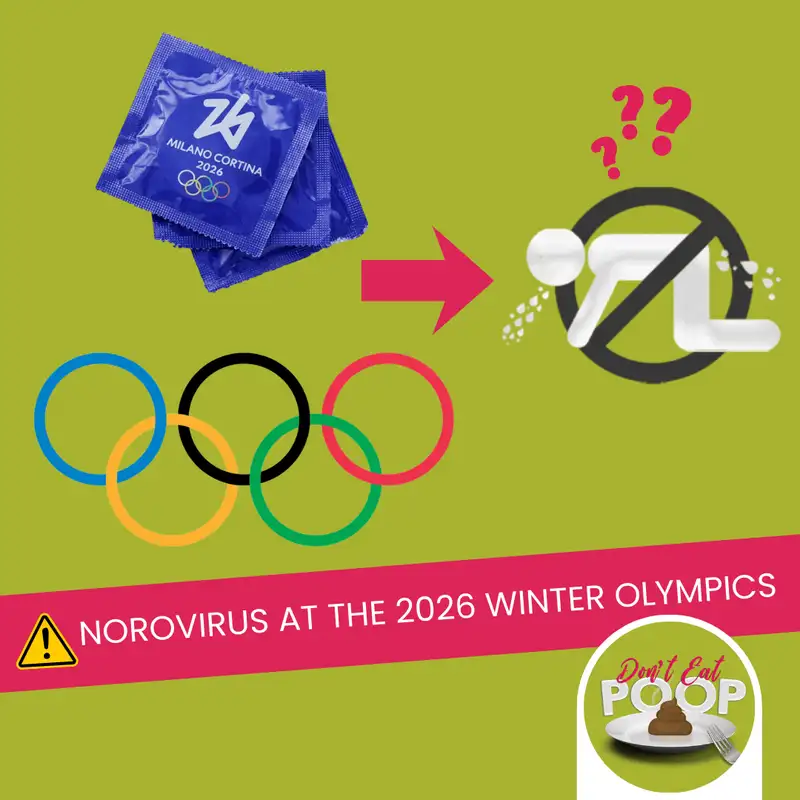
Francine L Shaw: All of the free condoms in the Olympic Village.
Matt Regusci: I think it was 10,000 of them. 10,000.
Francine L Shaw: 2,800 athletes were there the first week. Now, they've been handing out these free condoms since 1988, and I wonder if there's a correlation between the close contact and the Norovirus.
Matt Regusci: Do you think Norovirus can now be considered a sexually transmitted disease? Oh wait, this is, again, I love this quote from People Magazine.
The committee did not confirm the number of comments, condoms they procured for the games, but La Stampa [00:09:00] reported that it was less than 10,000 for the 2,871 athletes, significantly less than the 300,000 condoms the Paris organizers offered in 2024, though there were around 10,000 athletes for that.
Francine L Shaw: But wait a minute, in Rio, a record high 450,000. What? Are they not supposed to be practicing?
Matt Regusci: They're practicing for something. Maybe it's for one of the babies that I'm gonna end up with in Colorado Springs.
Francine L Shaw: You might wanna clarify that comment. There's a, don't you guys have a, an Olympic something there?
Matt Regusci: Yeah.
Francine L Shaw: A college.
Matt Regusci: The Olympic Center here in Colorado Springs.
So since they ran out, maybe we'll end up with one. They're like, no, we wanna put our kid up for adoption.
Francine L Shaw: I'm just like.
Matt Regusci: That'd be. That would be awesome to have an Olympian [00:10:00] baby. That would be cool.
Francine L Shaw: My perception of what they were doing when they got there has completely been blown out of the water.
Matt Regusci: When Francine and I were texting each other, this, the combo and the norovirus and the, and the lack of condoms, we were like, lack of condoms. By the way, 10,000 condoms for 2,800 athletes. That's. To go through that in one week.
Francine L Shaw: Okay. Do you have a math? That's only four a piece.
Matt Regusci: You have a partner, so that's actually eight a piece.
Francine L Shaw: Great point.
Matt Regusci: So yeah, there's obviously, okay, so going back to the Norovirus thing, they really have to figure this out because you have a bunch of athletes being fed in a diner. You would think, and we talked about this two years ago, you would think that the Olympic centers would be like, Hey, listen, these athletes are at the prime condition. [00:11:00] They are competing for medals. What we do in-house should not affect their ability to play a sport.
That's, to me pretty simple. So why are people showing up to work sick at these things? Because that's the only way to really get Norovirus is to spread it. If one person showed up with Norovirus, you can see how small amounts of people could get sick from other people, particularly given the statistics of condoms, right?
But to have big swaths of people getting sick. Like it's obviously coming from the food and I just find it fascinating. This is like your number one thing you talk about. You created Noroman.
Francine L Shaw: It says here, hygiene protocols. Teams like US women's hockey team reported avoiding physical contact such as hugs and handshakes to mitigate risk. [00:12:00] They left something out there apparently.
So in 2018, I don't know if you remember this or not. There was an outbreak as well. 200 people got sick and it was a large number of the security personnel and volunteers. Do you remember that?
Matt Regusci: Yeah. 200,000.
Francine L Shaw: 200 people.
Matt Regusci: Oh, sorry. 200 people.
Francine L Shaw: That's a big difference.
Matt Regusci: Yeah, that's a huge difference.
Francine L Shaw: I am sure I would think, I've never been to the Olympics, so I don't know. Do they have hand washing stations, do they?
Matt Regusci: Oh.
Francine L Shaw: Because the hand sanitizer does no good.
Matt Regusci: Yes. There are stories of people saying that they're just washing their hands continuously. Like the athletes are washing their hands and sanitizing continuously.
Yeah, because at what point in time does like a country just be like, listen, don't go eat at the public places. We are just gonna have your food delivered. Because I mean, you could just, we're talking about Milan, Italy, so. I'm sure there's [00:13:00] the ability for them to get food delivered or just go to the grocery store and I don't know, like maybe at some point in time one of these people being like, you know what?
We have enough money in our budget. We're just gonna rent a kitchen and that's gonna be our kitchen and we're just gonna feed you all of your specialized meals and stuff like that. Because a lot of these athletes are on extreme diets too, like very extreme diets.
Francine L Shaw: If and when the Olympics actually happen in the United States, the kitchen staff will have food safety training.
At least some of them will have food safety training. I would be surprised if they don't make them all take some sort of training, being that it's the Olympics. 'cause the last thing we want is some kind of foodborne illness outbreak, but at least some of them will have food safety training.
I wonder what type of food safety training, if any, they [00:14:00] had in Paris. I mean, I would think that they had some. That didn't necessarily have to come. It didn't have to come from the food.
Matt Regusci: It's true.
Francine L Shaw: It probably didn't.
Matt Regusci: Well, I don't know if someone was sick.
Francine L Shaw: It could have, but I mean, who knows where it originated. It takes such a minuscule amount of that virus, and it lives on surfaces for such a long time.
Matt Regusci: Yeah, yeah. We're blaming the food. We're blaming the kitchen staff.
Francine L Shaw: No, you're blaming. You're blaming the food.
Matt Regusci: Yeah. Yeah, I am. I totally am. I'm blaming the kitchen staff, and that may be misplaced blame. It could just because you have.
Francine L Shaw: I'm not saying it wasn't the kitchen staff at all.
Matt Regusci: But it could have come from the hundreds of thousands of people attending this thing.
It could have come from a lot of places. You're right.
Like a cruise ship, but they've, those cruise ships, man, they've got that thing locked down now after all those outbreaks.
Francine L Shaw: Some of them do. [00:15:00] It's, it's crazy. I have been, cruises still make me nervous, but I have been on a couple cruises that do a fantastic job since COVID with the whole hygiene, the hygiene protocols.
Just, I'm just astounded at the hygiene protocols that they've put in place.
Matt Regusci: Yeah. I haven't been in a cruise since my honeymoon, like over almost 25 years ago, but I couldn't think of anything worse than being stuck on a ship and having Norovirus and everybody else having Norovirus like that would be hell.
Francine L Shaw: Oh my. And this has to do with system failures, but there's a, on Netflix, there's a documentary called, I think it's called The Poop Cruise.
Matt Regusci: Oh my gosh. That was the wrong ti to take a sip of coffee. Oh my gosh. I was just spread that all over my computer. [00:16:00] It's called the Poop Cruise.
Francine L Shaw: I think that's what it's called.
Matt Regusci: How did I miss this? This is our show.
Francine L Shaw: First of all, it is a real shame what happened on that cruise, but it is, it's terrible. You should watch it.
Matt Regusci: Okay, so I just don't know the inner workings of how these ships work. Do they store all of the feces and stuff like that on the ship and then unload it when they go to dock?
Or did they just let that stuff fly into the ocean?
Francine L Shaw: Oh, I think it's stored in tanks because one of the things that happened is this stuff all started backing up through the showers. Oh, Matt, it is. It was horrible what happened on this cruise. Horrible. It was in the hallways. It was absolutely horrendous. What happened on this cruise.
Matt Regusci: When you remodel the boats, they just change the tile to like brown tile. So you don't know when it [00:17:00] backs up, they're like, oh no.
Francine L Shaw: It's.
Matt Regusci: Oh, the smell. Wow.
Francine L Shaw: And at one point they were asking people not to use the toilets, to use the showers.
Matt Regusci: Okay, I gotta watch this documentary. I'm gonna watch this with my teenage boys.
This is gonna be perfect. This is gonna be a bonding thing. They're gonna love this.
Francine L Shaw: I have to.
Matt Regusci: Teenage boys. Who am I kidding? I'm gonna watch this with my best friends.
Francine L Shaw: Yeah, teenage boys.
Matt Regusci: And sense of humor doesn't change after we hit, when we become teenagers. Most men, I'm sure some men do.
Francine L Shaw: Train wreck.
There's a series called Train Wreck. Train Wreck: Poop Cruise.
Matt Regusci: I'm down.
Francine L Shaw: It was Carnival Triumph in 2018. 4,000 passengers were stranded at sea without power, air conditioning or working toilets.
Matt Regusci: There was no power or air conditioning and was backing up?
Francine L Shaw: Oh, it was horrible. [00:18:00] Horrible.
Matt Regusci: Did that cruise line go outta business after that?
Francine L Shaw: Graphic descriptions and visuals of sewage as well as scenes of heavy drinking and sexual situations. Fits right into our talk, right into our podcast.
Matt Regusci: Francine, you are like full of one-liners today. Oh my God.
Francine L Shaw: It was, yeah. Unbelievable situation. Unbelievable situation.
Matt Regusci: Wow.
So, okay, so going to the, there was an article done on this by The Conversation, which we definitely referenced before, but they wrote an article that says When Norovirus hits the Olympics, The Science Behind The Spread thought this was fascinating. Norovirus is highly contagious virus, which all of our audience knows, causes inflammation, stomach to the stomach and the intestines.
It's the leading cause of foodborne illness worldwide. We did that on an episode when we were talking about the economics of [00:19:00] foodborne illnesses. Like Norovirus is like by far the highest one, but it's miserable. It is absolutely miserable. I'll think I got. So one of the infections my kiddo got in the emergency room was a GI infection.
I'm not quite sure it was Norovirus, but I had that over the last couple days. Not coming out of the mouth, but like every hour, like I lost seven pounds over the last couple days. I don't know if you, if look, luckily we are not a YouTube show. Anybody who's looking at this is like, that seems a little pasty and.
Francine L Shaw: Out of sorts and I like, is that a film over your screen or do you really look like crap?
Matt Regusci: I look like what I was doing for the last couple days 'cause it was miserable. Absolutely miserable. Drank a lot of Gatorade in the last couple days it was bad.
Although infections are often brief, they typically last 24 to 72 hours. Yes. And as of most miserable, 24 to 72 hours ever. [00:20:00] And the symptoms, quote unquote, are intense. I definitely agree with this article. They are very intense.
This I thought was interesting and we talk about this, but it's great that like an article writes about this, that people are gonna read. One reason Norovirus spread so efficiently and is extremely low infectious dose. Oh, it has extremely low infectious dose.
Fewer than 20 viral particles may be enough to cause illness by comparison. Many other viruses require far higher doses to trigger infection. So that goes back to what you were saying, like it literally could be just a tiny bit.
Francine L Shaw: So I did a graphic one time to show how few it took, and it was like a straight pin.
If anybody knows what a straight pin is anymore, they can fit on the head of a straight pin. Like, that's so minuscule.
Matt Regusci: Which is like the tip of a needle, right? Like a straight pin.
Francine L Shaw: Like a straight pin. [00:21:00] It was like, like a nail only way, way, way, way smaller than it.
Matt Regusci: What you use for sewing.
Francine L Shaw: It's not a needle, it's.
Matt Regusci: Yeah, but.
Francine L Shaw: Pin.
Matt Regusci: Just trying to give like an example, like the tip of an needle. Basically a straight pin.
Francine L Shaw: It's the flathead on top.
Matt Regusci: Yeah.
Francine L Shaw: Yes.
Matt Regusci: So not much. In practical terms, microscopic contamination on food surfaces or hands can be enough to make someone sick. The virus spreads primarily through fecal oral routes, yummy via contaminated food or water, direct person to person contact or touching, contaminated surface, and then the mouth or holding a baby.
Francine L Shaw: Changing a baby's diaper, getting poo on your hand and then you know.
Matt Regusci: Ah man.
Francine L Shaw: Your lip.
Matt Regusci: That is miserable to the poor baby.
Francine L Shaw: Going to the bathroom, not washing your hands, coming out, touching the doorknob and going into kitchen and making a sandwich.
Matt Regusci: I see other times.
Francine L Shaw: Someone going the bathroom before you touching [00:22:00] the doorknob.
Then you going out of the bathroom, touching the doorknob, going back to the kitchen and washing a sandwich. Sandwich.
Matt Regusci: Washing your sandwich?
Francine L Shaw: Don't wash the sandwiches, wash your hands.
Matt Regusci: Did you hand it off to your kid and be like, here's a poopwich. Enjoy it. It's what we call the fecal oral route. Enjoy your sandwich. Oh my gosh.
Also, Norovirus is remarkably resilient. It could survive on surfaces for days, which is exactly what you were saying. 'cause you have like a PhD and hard knocks of Norovirus. It can survive on surfaces for days withstanding freezing temperatures. I didn't know that. I don't know Norovirus like, you know, Norovirus.
I did not realize that it could be in freezing temperatures, which makes sense for the Winter Olympics. 'cause it's like freezing there.
Francine L Shaw: I don't know if you remember, there was a restaurant several years ago that had an outbreak and it came in their, I believe it was their frozen strawberries.
Matt Regusci: Yes, I do remember that.
[00:23:00] Gosh, can you imagine the root cause analysis to finding Norovirus in frozen strawberries? Another thing is hepatitis was on frozen berries for a while too. Remember that?
Francine L Shaw: I don't think it was hepatitis. I think it was Norovirus.
Matt Regusci: Well, no, no, but there, there was hepatitis in, I think, frozen blueberries a while ago.
There was a, an outbreak and a recall on frozen berries. Okay. As bad as Norovirus is, I would rather have that over hepatitis any day. Holy cow. Here goes your kidneys, here goes your liver. It's not good. And then to your point too in the article, it's not reliably killed by alcohol based hand sanitizers.
Like Norovirus is like a super bug man. It has good survival skills. I gotta hand it to Norovirus. It is a maximum survivalist. So making sure to thoroughly wash your hands with soap and water is essential.[00:24:00]
And so then it says why the Olympics are a perfect storm. The Olympic Games bring together thousands of athletes, coaches, support staff, and spectators for several weeks of intense competition with back-to-back events, teams, meetings, travel between venues, athletes are in near constant contact with teammates, competitors, and staff, the shared spaces of the Olympic Village, even small exposure, can allow infection to move quickly. And we all know based upon the condom usage, there's a lot of exposure to other teammates from other countries across the Olympics. A lot.
They're having a lot of fun. I wonder if they consider that cardio, by the way.
Francine L Shaw: So maybe because I was thinking. I thought they were supposed to preserve their stamina.
Matt Regusci: Maybe a 10, 20 minute sprint.
Francine L Shaw: For their events. But maybe it is cardio. I, I don't really, I don't know,
Matt Regusci: Rapid [00:25:00] turnover of participants. Maybe they could have used a better word. And the arrival of athletes to multiple countries further increases the risk. Different viral strains can be introduced and those infected may unknowingly carry the virus. To others or even back home.
Yeah. That's interesting too, because it's a virus, so it's constantly evolving. So you can have a Norovirus from Russia, a Norovirus from Canada, a Norovirus from China, a Norovirus from the US, and they all come together and you're getting a bunch of different strains, just commingling together and having fun. It's a party.
Francine L Shaw: Back to what I was saying, norovirus outbreaks are frequently linked to contaminated frozen berries.
Matt Regusci: It's frequently linked to frozen berries. Oh, okay. That makes sense. Because berries are handpicked, like strawberries are handpicked. So if you have a harvest crew worker, or because harvest crew workers are all close together and they're using the same [00:26:00] porta-potties, norovirus could spread really quickly through a harvest crew.
And then if they're working and they're picking those berries and then it's going directly to the freezer, and that freezer is not killing the Norovirus. That would make sense how it would be frequently done. 'cause it's a little berry and it's handpicked. Yummy.
So harvest crew food safety is very important. It's one of the four main things that people look at during food safety inspections. Yeah, the fecal oral cycle. Yummy.
Oh, after the last two days this is a fantastic conversation.
Oh man, my wife has Purell soap dispensers everywhere and Purell hand sanitizer things like they're widely used right now.
Everybody is like washing their hands in my house. Like continuously.
Francine L Shaw: I'm out of the Purell [00:27:00] spray. I need to get some, 'cause I use, do use that stuff like crazy. The spray, not sanitizer, but the surface cleaner.
Matt Regusci: Yes.
Francine L Shaw: I love that stuff. Love it.
Matt Regusci: My wife broke one of those open again. Francine, I don't know how long ago.
What was it was during COVID? It was.
Francine L Shaw: Yeah, it was right after COVID, I think.
Matt Regusci: Yeah, it was like five years ago or something like that. And Fransine is like, what's your address? I'm like, why? She's like, I'm sending you something. I get like the UPS or FedEx thing and it's telling me the box weighs like 70 pounds.
And I'm like, did you mail yourself to me? What? What is in this box? And it's like 20 of these emergency Purell kits for, for restaurants.
Francine L Shaw: Norovirus kits.
Matt Regusci: Yeah, Norovirus kits. Oh man, whenever there's an outbreak in my house, my wife pops open those kids and all see the remnants of it. [00:28:00] 'cause it's she, it's like an emergency for her.
So she's ripping the thing open, she's pulling the stuff out, she's spraying everything and everybody, and those are lifesavers, Francine, absolute lifesavers. Like you should put that as something to sell.
Francine L Shaw: On Saturday. I was thinking about you because my grandson was at my house and Saturday morning he got sick.
He vomit and diarrhea. And I'm thinking, man, I wish I had one of those kits as I'm in the
bathroom praying that I don't get sick while I'm cleaning this up with the bleach.
Matt Regusci: It is like being married to a NICU nurse and then having you as one of my best friends. The amount of sanitization stuff that we have in our house for things like this is amazing. I don't appreciate it until things like this happen and I'm like, oh, this is nice. This is good.
Literally, the [00:29:00] Purell soap dispenser, the antibacterial soap dispenser's in every single bathroom, and she has the hand sanitizer ones like in a couple, like on the floors of our house. She has them constantly stocked. She makes it very easy for my kids to wash their hands.
'cause you just, and if soap comes out and Yeah, it's like the exact same stuff they use in the hospital, the Purell soap dispenser things and the hand sanitizer stuff. But that kit, you used to sell those kits, didn't you?
Francine L Shaw: Yeah, yeah. I did a campaign for them, helped them with a campaign and we, as a result, sold some of their kits, the norovirus kits.
Matt Regusci: Do you still have those?
Francine L Shaw: Do I have them?
Matt Regusci: Yeah. Do I like, do you still have 'em on your website?
Francine L Shaw: I dunno if they still sell them or not. No. We've narrowed our website down quite a bit to try to streamline it.
Matt Regusci: That goes to show you, like you would think there would be a huge [00:30:00] market for those in restaurants and I guess they couldn't sell one.
Francine L Shaw: Restaurants, schools, colleges, universities, just everywhere.
There should be a market for those. They're, they are fantastic. We didn't stop selling them because I'm not a fan of them. I'm a huge fan of them. I just, we tried to streamline our website.
Matt Regusci: Yeah, that makes sense. And if they were selling on your website either. If they were selling on your website, you wouldn't pulled it down.
Francine L Shaw: Just not enough to warrant. They weren't easy to ship either.
Matt Regusci: No, I totally get it. What you sent me was like a 70 pound box. That must not have been cheap.
Francine L Shaw: No. Wasn't.
Matt Regusci: Oh my gosh. When they showed up my wife.
Francine L Shaw: Our ROI on those packages was not good.
Matt Regusci: Now my wife was like, this is Christmas. And I remember too, 'cause we sent you. My wife was sewing.
'cause my family sews, my mother-in-law, my wife, my daughters, they sew. I remember we [00:31:00] sent you those masks. Yes. Remember you couldn't buy masks and we sent you for your kids and your grandkids like a whole bunch of masks. It was definitely a good trade. We beat this one to a pulp.
Francine L Shaw: We sure did. So.
Matt Regusci: What a fun topic.
Francine L Shaw: Whether or not the close contact helps spread.
The super spread of the norovirus. We do not know, but we certainly believe that it didn't help.
Matt Regusci: Now the condoms will protect against a lot of different things, but I don't think Norovirus is one.
Francine L Shaw: How many athletes will have babies in November?
Matt Regusci: We'll find out when the Colorado Springs population increases.
We'll know. Oh man. Alright.
Francine L Shaw: And what will be the number of condoms that they put in the Olympic Village next time?
Matt Regusci: Yeah. To go from 300,000 to 10,000. That was poor planning.
Francine L Shaw: What were they thinking?
Matt Regusci: It [00:32:00] was poor planning.
Francine L Shaw: Who was in charge of that? They didn't do the research.
Matt Regusci: No, they did not. Alright, on that note, definitely for this episode, don't eat poop.