Insects & Lab-Grown Meat: The Future of Food Safety Compliance | Episode 160
DEP E160
===
[00:00:00] Matt: Regulators and business approach. No edible insects are permitted to be sold in the uk, but following exit from the eu, yellow mealworms house, crickets, banded crickets, and black soldier flies can remain on the market until an authorized decision has been made. So this must be for animal food and for human food because black soldier flies.
Okay, so black soldier flies are used a lot for animal feed. And you're not actually eating the black soldier fly. What I've done with chickens and stuff like that, really you're putting meat like ted meat and scraps like in a bucket, and you have the black soldier flies in there and they lay their larva eggs in the food, and then the little mags.
So you shake the bucket and they flop out and the chickens eat it. It's like a protein snack or chicken.[00:01:00]
[00:01:06] Intro: Everybody's gotta eat and nobody likes getting sick. That's why heroes, toil in the shadows, keeping your food safe at all points from the supply chain to the point of sale. Join industry veterans, Francine l Shaw and Matt Reci for a deep dive into food safety. It all boils down to one golden rule. Don't eat poop.
Don't eat poop.
[00:01:31] Matt: Hello? Hello, Francine.
[00:01:33] Francine: Hey, Matt. Is that a real Starbucks cup I see there in your hand now? Is somebody delivering coffee to you?
[00:01:39] Matt: Yes. Geez. I think my father-in-law got coffee. Somebody in my house got coffee and they brought me, oh, well, when I said to you, Hey, I need to go grab my coffee. It was out in the kitchen.
It had just been delivered to the house. So yeah,
[00:01:54] Francine: living the life.
[00:01:56] Matt: It's nice. It's nice having so many adults in my house because, [00:02:00] so last episode we were talking about dividing up chores. My father-in-law is like the taxi driver in the house. He loves doing that. So like my kids won't even ask, well, they'll ask him for a ride first.
I'll find out from him that one of my kids is going to a friend's house or something like that before they ask us. So,
[00:02:22] Francine: so, you know, I had a real monster habit and then a soda habit. I no longer drink energy drinks.
[00:02:34] Matt: Really?
[00:02:36] Francine: I have not had one, and I'm not gonna say that I wouldn't, but I have not had one in months and soda, rarely drink a soda coffee, like one a day. That's it. Yeah, cut it all out.
[00:02:52] Matt: I usually do one coffee a day.
Today was two because I had a coffee from yesterday that I didn't drink. [00:03:00] So I reheated, I just reheated that this morning because somebody in the house will grab a Starbucks or whatever and then if it's late, if it's 11 o'clock my time, I just don't, I don't drink coffee in the afternoon anymore. I used to drink coffee like all day long or sodas all day long.
But yeah, today is the two cup day.
[00:03:17] Francine: Yes. Like the monster thing was out of hand. I'm not, again, not gonna say that I wouldn't, but I just, I have not.
[00:03:25] Matt: So you. You were drinking one a day, like every day,
[00:03:30] Francine: every
[00:03:30] Matt: single. When did you stop? Now that you say that I've, I haven't seen you with a monster in a while.
[00:03:34] Francine: Probably August.
[00:03:38] Matt: Whoa, so six months. What are you doing to control your A DHD?
[00:03:44] Francine: Nothing.
[00:03:48] Matt: Okay. Yeah, because like, like I use caffeine for that, so
[00:03:52] Francine: Yes. So do I.
[00:03:54] Matt: That's fun.
[00:03:56] Francine: Like wine, coffee a day. Yeah.
[00:03:58] Matt: Yeah.
[00:03:59] Francine: Yes. [00:04:00] Caffeine is definitely a regulator.
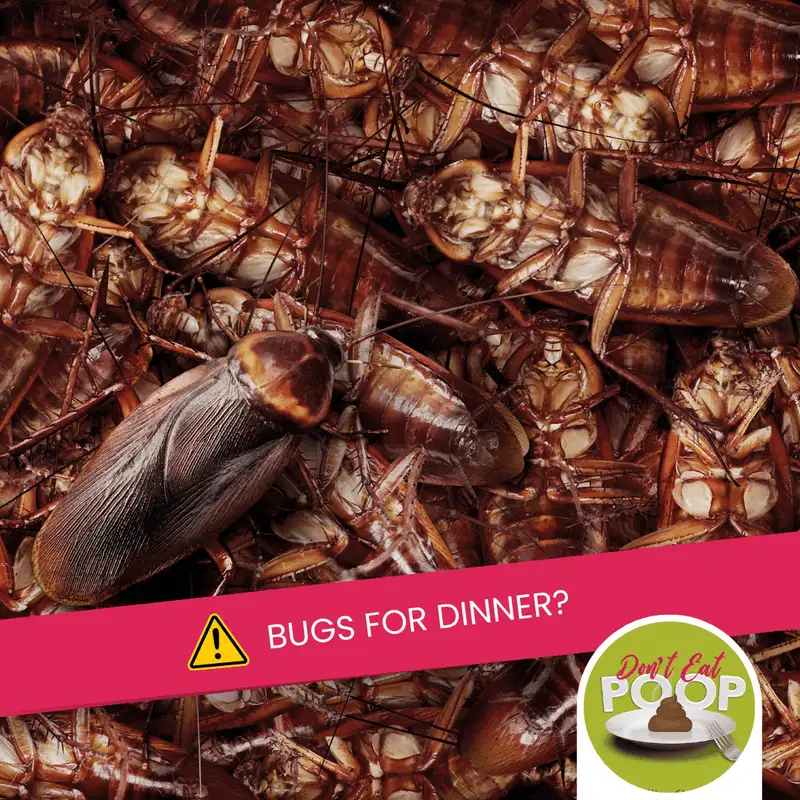
[00:04:02] Matt: Okay, so today's topic on food safety news, we just had to talk about this because it went from being a fad to like. Being a thing, and so now regulators are gonna have to figure this out.
So Insects, the title is Insects and Cell-Based Food on Radar of Food Regulators. Food Safety News March 16th. I remember looking at this a decade ago when people were like literally growing crickets in their house and then dehydrating the crickets and then making like protein. Flour from crickets in like mealworms and stuff like that.
My wife went to go grab something for the room and she stopped at the door and looked at me like, I'm fricking insane when I said this. Okay. I thought it was like a fad. I thought people were gonna do [00:05:00] this and it is gonna be a fad. I don't think it's a fad anymore. Like you're European and cultures are like eating insects for like.
Extra protein. This is a thing now. And of course Europe is going to figure out a way of regulating it before the US can't figure out how to regulate normal food, let alone up and coing stuff. But you and I have had conversations about cell-based food, right? They call it like, not meat. Meat, right? Fake meat.
Meat. And in the US the biggest thing that they're regulating is whether or not it could be called meat. Not whether or not it's safe.
[00:05:41] Francine: Right.
[00:05:42] Matt: Okay. So what do you think? Do you think, okay, so the 3D printing of meat that is, I don't know. Do you think, is it profitable? Are they gonna get to a point at which it's profitable to make meat in a lab?
[00:05:57] Francine: I can't even wrap my head around how that works. [00:06:00]
[00:06:00] Matt: One of the big things about doing this in a lab is it's supposed to be once they scale, this is supposed to be. More efficient and more environmental friendly to grow meat in a lab, and obviously, quote unquote, more humane. Although you and I have both dispatched animals, if you do the dispatching correctly, it's pretty humane.
Like they're happy and then they're gone. Right? It's like instant. What I can't wrap my head around is by building factories most likely on arable land, right? Factories, wherever the factory is. It could be in the middle of a city, it could be out in the country, wherever you're putting a factory in. And then you have lights, you have energy, you have all of these things that go to making meats in a lab.
And the only way I could think about this being [00:07:00] energy efficient is if we actually went to nuclear energy. Right, because where does our energy come from in the us? Yes, we have nuclear facilities that are dying off because we are not building any new nuclear facilities at a fast enough rate. And so we're using liquid, natural gas and coal to create our energy for the most part.
I mean wind and solar and stuff like that, but on massive scale, wind and solar aren't efficient. So you're building these factories and you're building these labs and I know how much energy a lab takes 'cause I run a lab. We're testing food, we're not making food. So I can only imagine the energy it takes to actually make 3D print food has to be a lot of energy.
I just don't see how it's more energy efficient.
[00:07:55] Francine: What are the risks?
[00:07:58] Matt: What do you mean? What are the risks? [00:08:00]
[00:08:00] Francine: In creating this meat, what are the risks?
[00:08:04] Matt: In terms of what? Safety, like in terms of food safety,
[00:08:06] Francine: safety.
[00:08:09] Matt: Well, if the facility is not sanitized, whatever's in that machine and whatever, or instrument and whatever is in the containers or whatever that they're doing to create this fake meat are going to get contaminated.
It has to be sanitized.
[00:08:24] Francine: Are we gonna create a whole new barrage of foodborne illnesses?
[00:08:29] Matt: Oh, like a super foodborne illness because they are all sanitized and clean. Like a super listeria in there or something. Because I could see listeria getting in there.
[00:08:41] Francine: Different things we need to worry about other than are we just opening?
[00:08:46] Matt: I'm sure. I'm sure there's gonna be some sort of outbreak in this in the future. Yeah. Well, that's a reason why the regulators are looking at it, so. Regulators and business [00:09:00] approach. No edible insects are permitted to be sold in the uk, but following exit from the eu, yellow mealworms house, crickets, banded crickets, and black soldier flies can remain on the market until an authorized decision has been made.
So this must be for animal food and for human food because black soldier flies. Okay, so black soldier flies are used a lot for animal feed. And you're not actually eating the black soldier fly. What I've done with chickens and stuff like that, really you're putting meat like ted meat and scraps like in a bucket, and you have the black soldier flies in there and they lay their larva eggs in the food, and then the little.
Bag kits, you shake the bucket and they flop out and the chickens eat it. It's like a protein snack or chicken. I don't think humans are [00:10:00] eating that. That would be disgusting if humans are eating that.
[00:10:03] Francine: Did you ever watch Fear Factor?
[00:10:05] Matt: Yes.
[00:10:06] Francine: I just can't get that outta my head right now.
[00:10:09] Matt: One episode and I was like, I'm done.
I, this is not fun watching. That is not fun. It's disgusting. Technologies such as molecular farming are also in early stage while reverse food manufacturing and 3D printing need longer term monitoring. The UK system relies on pre-market authorization, under novel food framework before the products are approved to sell.
So like the us, right? There's these little loopholes that you and I have talked about for emerging type of food, managed by county or by city, or. By state or whatever. Emerging technologies are reshaping how our food is produced and sourced. This report gives industry and the government clear sight of what is coming and what is required to ensure these products meet UK's high [00:11:00] standards.
So this is really interesting 'cause it's not EU anymore, 'cause a Brexit UK is no longer part of that. So they're creating kind of their own food standards and they're looking into this. I really like your thought though. I was not thinking the food safety issues in 3D printing, but if you're creating food in a lab and it is super sanitary in this lab, let's just assume that they have amazing processes and stuff.
What happens when a listeria outbreak does happen in that facility? And it is super sanitized. Are you creating like a super listeria over after, I'm not saying like today, but like a decade from now. Are you creating like a super listeria
[00:11:50] Francine: something somewhere ultimate will happen?
[00:11:55] Matt: Yeah. I wouldn't think a coline in salmonella, right?
Because a eye in salmonella, [00:12:00] the reason why that's on chicken and cows is because it's on the chicken, it's on the cow from. Fecal matter, right? So in the lab, theoretically you wouldn't have fecal matter, but you could totally get a listeria contamination in there. If it's like 20, 30 degrees in there. In this lab, somebody doesn't do the proper protocol and brings, you always have the human
[00:12:34] Francine: element.
[00:12:35] Matt: Yeah, that's what I'm saying. Somebody brings it in beyond just the scalable side of things. Say this does get to a point at which we figure out how to scale printing meat in a lab and it tastes just like meat. You can't tell the difference what food safety risks come from that in the future, I guess to be determined.
Huh?
[00:12:59] Francine: I [00:13:00] don't know. And I just feel like we have so much to do before we even think about that.
[00:13:05] Matt: Oh my gosh. Do you ever go on Facebook? Marketplace e-commerce just made me think about this. TikTok, do you ever go on Facebook? TikTok or TikTok, but like Facebook Marketplace. Okay. This is
[00:13:16] Francine: Facebook marketplace.
My husband. Oh my God, yes. Facebook marketplace. Yes.
[00:13:22] Matt: People sell all types of food on Facebook Marketplace.
[00:13:25] Francine: Oh, I know.
[00:13:26] Matt: Like all types of food My wife and I were looking at and I was like. What are their kitchens like? I would never, ever buy anything on Facebook Marketplace. Wait, so last week we were talking about our house cleaner.
She's like kind of, her and her family have become part of our family. She is super, super clean and her family are super clean. So she comes over like with her daughter and her nephew and all this super type of stuff, and they clean the house. They [00:14:00] bring us food. 'cause I've love Mexican food and it Colorado Mexican food is more like Tex-Mex, not the Mexican food.
I know from like California, where it's a different type of Mexican food, they'll bring me like tamales and that type of stuff. And I trust that because I know how they clique. I know their kitchen is gonna be really cleave because I know how they cleave. But like buying food on Facebook, marketplace, blah.
[00:14:29] Francine: There's not a chance. So remember that thing I sent you a couple weeks ago about the bring your own dish? Yes. Game, wild game. Yes.
[00:14:41] Matt: What I seen sent over to this thing where they were doing like a fundraiser. It's like a Pennsylvania thing, right? It was like a thing in Pennsylvania. They were doing a fundraiser and it was bring your own meat, cook.
The way you cook it like that is game that you've hunted.
[00:14:58] Francine: So I didn't [00:15:00] have time to stop and take a picture. I so wanted to, I was on my way home the other night and I passed a sign along the road that said, wild Game for sale. I'm like, what? What are we doing here? Just a handwritten sign. Wild game for sale.
So it was written on plywood with green paint.
[00:15:22] Matt: Your husband goes out hunting, right? Like you guys get
[00:15:25] Francine: my entire family hunts? Yes.
[00:15:26] Matt: Yeah. And so. I would give boar meats or I would get boar meats from like friends and family and stuff like that, or elk meat or whitetailed, like deer meats or whatever. It's friends and family giving it to me and me giving it to them.
Like we'd make sausage or whatever with it, or jerky or whatever. But isn't it illegal to sell it?
[00:15:46] Francine: Yes. Just along the street sign like that? Yes. Unless you've got a special license and Yeah, you can't just. You can't just sell it like that.
[00:15:55] Matt: Yeah, because you have to like raise it and make sure you know what it eats and all that different type of stuff.
[00:15:59] Francine: You can't [00:16:00] just put a sign out along the road. You have to have a special license to be selling wild game. It has to be raised. You can't just go out in the woods and kill it and sell it.
[00:16:11] Matt: Okay, so here's a question for you. Would you eat. The 3D printed meat thing, there's still a lot of variables that to come with that clean label project.
We certify some of this meat, so I've tried it. It tastes fine, tastes good. I getting it to scalable purpose though, is I think is gonna take some time. But like the insect thing, would you eat an insect?
[00:16:37] Francine: No. I've eaten a lot of things. When I went to Peru, I ate local cuisine,
[00:16:44] Matt: Guinea pigs.
[00:16:45] Francine: Alpaca.
[00:16:47] Matt: Yeah, but that's different, right?
Those are mammal.
[00:16:50] Francine: I'm not, no, not an insect. I just can't get past a mental, it's a mental hangup.
[00:16:58] Matt: Yes. [00:17:00] So I grew up in San Luis County and in San Luis County there is this candy. Store that's been around candy manufacturing places. That's in Grover Beach. That's been around for as long as I can remember.
And they make suckers and they'll have scorpions in them. Mealworms in 'em, all this different type of stuff. Yeah. So that was where like that was a gag thing. I mean a gag gift. Not a gag as you're eating it, but I've seen people do that.
[00:17:34] Francine: I would gag 'cause I ate it.
[00:17:36] Matt: So we would eat, like we would get up and then it was a, it is a novelty thing and now I see it like the local seven 11 to my house, like two blocks, one block away.
They had those on the counter and they were selling them. And I know how much they sell 'em in Grover Beach. And they had marked these things up like. A thousand percent. It was like [00:18:00] $5 per sucker or whatever. And I said to him, the box had just been open. And I was like, oh, I'm from there. I know this exactly.
And they're like, oh, really? Because I've gotten to know these people, the owners of the seven 11. And I was like, yeah, this is, I wonder how they do. Two days later, the one of the owners says to me, we sold outta the box. We're buying more.
[00:18:23] Francine: God, I can't imagine thinking. Oh wow. I'm craving a cicada. I'm craving a chocolate covered cockroach today.
I think I'm,
[00:18:32] Matt: oh my God, I was sip my coffee all over. I can't think I'm craving a cicada.
[00:18:39] Francine: Do you know where I could grab a grasshopper?
[00:18:42] Matt: Okay, so I've eaten them. They're fine. I've eaten them in another country's like. Grasshoppers that were like, salt, chili, sugar, whatever. They're like snacks. They taste just like whatever, seasonings on them, plus a crunch.
Its like eating protein chips perfectly fine. [00:19:00]
[00:19:00] Francine: I think that's my line. Like I've eaten a lot of things that I think that's my line. Knowingly eating insects. I think that's my, and again, a lot of things, I think that's my line.
[00:19:16] Matt: Okay, so in England in part of this article, findings came from a survey, which is probably why they're like, we actually need to like figure out how to regulate.
This findings came from a survey of 2000 adults, so a pretty big survey in England, Wales, and Northern Ireland in December of 2025. So very recent by the cellular agriculture manufacturing hub. I'm surprised they haven't turned that into an acronym. They probably have. The top concerns people have about food produced by innovative technologies relates to food being made in a way that is not natural and its safety, as well as its lack of information about the technology.
So the biggest thing that people have about like this [00:20:00] printing of meat is, is it safe? What's the technology being used? I think also environmentally, is it environmental? Is it good for the environment? But around half of the survey respondents were confident that the UK government put safety first when approving food made by innovative technologies, which probably made the UK government go, well, maybe we should look at this.
Willing to eat such products varies, but consumers generally show caution. They are most willing to try products made using controlled environment agriculture, 64%. Most are hesitant about molecular farming, 38% and 3D printed food at 30%. They're worried about it, which actually to me means that means 70% are not,
[00:20:50] Francine: it's changed.
People don't like change. So it's fear of the unknown is what I would think it is. Yeah.
[00:20:59] Matt: With the [00:21:00] Grasshopper and the Mealworm thing, like when I was looking at the research, because it didn't. It, it doesn't bother me like eating. That doesn't bother me at all. My whole family, there'd be no way in heck that they would eat anything like this.
I would have to like put it in there and not tell 'em it was in there if it was gonna eat it. But like they're grinding this up, like they're raising these bugs, they're freezing 'em so that they die a humane death basically by getting rid of the exchange. I don't
[00:21:31] Francine: wanna freeze.
[00:21:32] Matt: Supposedly it's humane. I freezing that.
Then they go through like a process and they dry 'em and then grind them up and they make this protein powder outta bugs. 'cause there's a lot of protein in bugs. A protein powder is way, protein powder is like a byproduct. It's not. That expensive and growing bugs on a massive scale [00:22:00] to use as an alternate to protein powder, whey protein powder.
To me, like that's gonna be hard to get to a scale and not have something go wrong. Like,
[00:22:11] Francine: I need to order some ant protein from Amazon.
[00:22:14] Matt: You can't. You could go like Google it and order get bugs, protein sludge, or
[00:22:23] Francine: some chocolate covered ants.
[00:22:27] Matt: It's gonna be a while before
[00:22:30] Francine: I'll be dead.
[00:22:34] Matt: I think it's gonna be a while before Both are mainstream, massive scale. There has to be a market at which enough people are willing to do it. So it's like a chicken and an egg thing, right? Like you have to have the market, you have to build the market for this. In the United States, in Europe and stuff like that.
Then you have to [00:23:00] simultaneously, while building the market for it, you have to be able to figure out how to scale this to meet the market which you're building. You have to have investors that are willing to invest and wait for that to happen. I don't see it happening unless some family. Probably a rich family goes, you know what?
I want to invest in this. I see this as the future, and I'm okay not making money for the next two decades until we get enough people to eat this. I just, I
[00:23:29] Francine: don't
[00:23:29] Matt: know,
[00:23:30] Francine: generations, maybe two generations below me will be much more open to it, like your children and maybe their children will be much more open.
[00:23:44] Matt: Well, and everybody's worried about feeding the world. Oh, we can't do, we can't have cattle because we're gonna have, we're gonna have to raise way more cattle for the generations that are coming up and the world is gonna be [00:24:00] overpopulated. But I don't know what charts they're reading, because the ones that I'm reading are like, we're going to have a population collapse in the next.
20, 30, 40, 50 years, we need more human beings, not less so. It almost sounds like we're trying to solve a problem that existed potentially 30 years ago that now everybody realized is that's not the problem we have where we're gonna be overpopulated. The problem is that we're gonna be underpopulated.
[00:24:34] Francine: My generation, there was population.
[00:24:37] Matt: Yeah, millennials too. Like I'm the oldest of the millennials and that was like our fear was the world is gonna be overpopulated, but the China one child policy got reduced. Their population so much. South Korea, Japan, us, we're not populating the earth right now. We're [00:25:00] so, it's almost like we're solving, we have a solution for something that existed a while ago that no longer exists today.
Because it's pretty efficient. Cows are efficient. They eat grass, they grow weight. You transport them to a feedlot or you transport them directly to the butcher and then it's done. You don't have to worry about creating a massive manufacturing plant with labs and lights and control temperature and all that stuff.
[00:25:31] Francine: In my mind, that would be much more expensive than livestock.
[00:25:39] Matt: So to be determined on whether or not insects and 3D meat printing are going to be a food safety problem that we have to manage in the future,
[00:25:51] Francine: I would quickly become a vegetarian.
[00:25:53] Matt: Oh, I like crave protein. I would totally eat insects. Before I became a vegetarian, I tried [00:26:00] doing vegetarian.
I'm, I'm a terrible vegetarian,
[00:26:04] Francine: so. I can remember for some reason when I traveled a lot, I ate less meat. And if I go a while without having meat, I will also crave, I'll start to crave, especially red meat, I'll start to crave red meat. It's like I need to steak like now.
[00:26:24] Matt: Yeah, 100%. 100%. And it for me, I'll eat any meat.
It doesn't matter as long as it's meat. I eat more meat than I do carbs. Yeah. But I would, so for me, no, I would totally give me a bag of insects, like I'll eat that
[00:26:42] Francine: again. I think that's my line. Peanut butter, even though I know what could potentially be there, it's peanut butter would be my protein.
[00:26:52] Matt: Oh, you know what would be, you know what would be interesting is dipping one of those crickets and peanut butter.
So then it just like protein squared.
[00:26:59] Francine: Just get a praying [00:27:00] manna. Oh wait, I don't think you're allowed to kill those. So we probably shouldn't. Pre man
[00:27:04] Matt: is like the coolest animals ever. But I'll know like, yeah, coolest insects ever. Excuse me. They're manna,
[00:27:10] Francine: the female bites the head off the male. Maybe we could just eat the males.
[00:27:16] Matt: I don't know. Maybe I have a thing against eating cannibals. Oh,
[00:27:21] Francine: oh. There's something wrong with us.
[00:27:23] Matt: On that note, don't eat poop.